

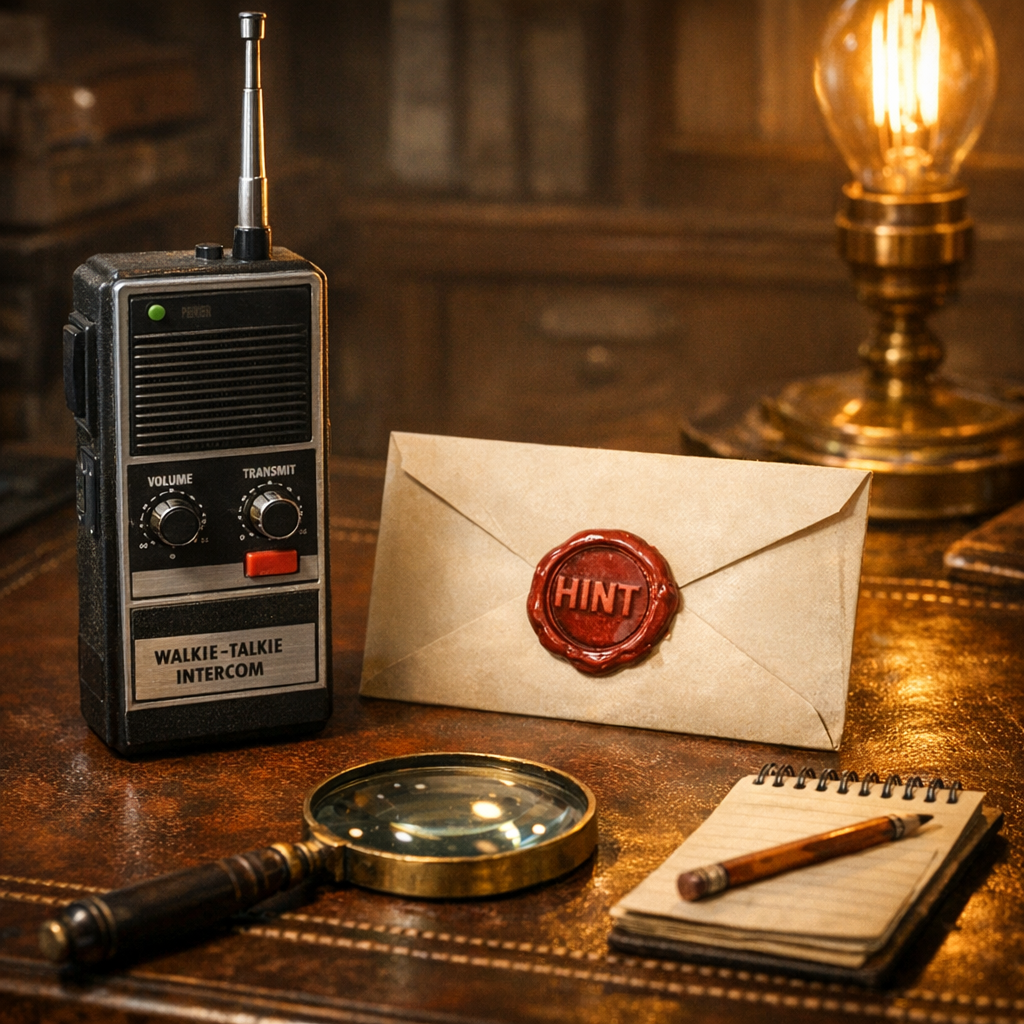
Short answer: most Orange County escape rooms offer unlimited free hints — you can ask as often as you need without penalty. A minority cap hints at 3 or charge time penalties. Always confirm the hint policy when booking. Using 2–4 hints in a 60-minute room is normal and expected — they’re built into the design, not a sign of failure.
The Three Hint System Models
Every escape room operator uses one of three approaches:
| Model | How it works | Common at |
|---|---|---|
| Unlimited free | Ask any time, no cap, no penalty | Most independent operators including Infinity Escape |
| Capped (typically 3) | Limited number per game, often via “hint coins” or push-button system | Some national chains, premium operators |
| Time penalty | Each hint deducts 1–3 minutes from your remaining time | Competitive-mode operators, certain themed rooms |
The trend over the last 5 years is toward unlimited free hints. Capped and penalty systems made sense early in the industry when puzzle design was new and operators wanted to feel “earned” wins, but they create friction and unhappy customers. Most modern operators have abandoned them.
How Hints Are Delivered
Operators use a few different delivery mechanisms:
Game master via screen / TV in the room
Most common in OC. A monitor or screen displays text hints when the GM types them. Players ask out loud (“we need a hint on the lock”), GM types a response, players read it. Pros: subtle, doesn’t break immersion. Cons: requires players to look at the screen.
Game master via speaker / radio
GM speaks hints over a speaker. Some operators use a “walkie-talkie” prop the players carry. More immersive but louder and can interrupt teammates.
Hint button / push-to-request
Some rooms have a physical button you press to request a hint. Often paired with a hint cap (e.g., 3 button presses allowed). Tactile but can feel game-like.
In-character clue characters
Premium experiences sometimes use a “guide character” in the storyline who delivers hints. Most expensive to operate, rare in OC.
How Many Hints Should You Use?
Across the industry, the average successful team uses 2–4 hints per 60-minute room. Here’s the breakdown:
- 0–1 hints: Either a very experienced team OR an unusually easy room. Bragging rights, but rare.
- 2–4 hints: Normal. The room was designed with this many “stuck points.” You’ll escape with time to spare.
- 5–7 hints: The room is on the harder end OR your team is missing a key skill (math, observation, communication). You’ll likely escape near or at the buzzer.
- 8+ hints: Either the GM is being generous, or you’re seriously stuck. Many rooms cap actual escapes at this point — past 8 hints, you’re being walked through the room rather than solving it.
Pro tip from the operator side: teams that use hints early (around the 15-minute mark) escape more often than teams that try to white-knuckle it for 30 minutes before asking. Hints are a tool, not a failure.
When to Ask for a Hint
Strategy matters. Here’s when to ask:
1. After 5 minutes of zero progress on a single puzzle
If your group has been staring at a single lock or clue with no idea what to do for 5 full minutes, ask. The puzzle is designed to be solvable in under 5 minutes once you “see it.” More time staring won’t help — fresh information will.
2. When you’ve found a clue you can’t make sense of
You found a number, a symbol, or an object — but you don’t know what it goes to. Ask: “We found this number. What does it apply to?” The GM will redirect you.
3. When the team is splitting / arguing
If two people are convinced of two different solutions and stuck, ask. The argument wastes time. The GM can resolve it in 10 seconds.
4. When time pressure is closing in (15 min left)
Don’t try to be a hero in the final 15 minutes. Ask for hints freely — you want to ESCAPE, and a hint-aided win is still a win.
When NOT to Ask for a Hint
- You haven’t searched the room yet. If your team hasn’t fully searched the space, ask each other before asking the GM. Don’t waste a hint on “where do we look?” when the answer is “everywhere.”
- You haven’t communicated as a team. Half the time, someone in the group already knows part of the answer. Talk first.
- The puzzle is fresh (less than 2 minutes in). Give your brain a chance.
Hint Etiquette: How to Ask
Game masters love specific questions and hate vague ones:
Good asks
- “We’ve tried these four combinations on the box. Are we close?”
- “What do these symbols on the wall correspond to?”
- “We’re stuck on the math puzzle. Can you nudge us?”
Bad asks
- “We need a hint.” (GM doesn’t know which puzzle.)
- “Just give us the answer.” (GMs typically guide, not solve.)
- “Is this thing important?” (Without context, GM has no way to help.)
Be specific about what you’ve tried and what you’re stuck on. The hint will be much more useful.
The “Hint Tiers” System
Most operators (us included) deliver hints in tiers when you’re really stuck:
- Tier 1 — Nudge: “Have you looked closely at the framed picture on the back wall?”
- Tier 2 — Specific direction: “There’s a number hidden in the picture. Examine it more carefully.”
- Tier 3 — The answer (rare): “The number is 472. Try it on the small lock.”
If your group is enjoying figuring it out, GMs use Tier 1. If you’re frustrated or short on time, they escalate. Most groups never need Tier 3.
What We Do at Infinity Escape
Honest take from our side:
- Unlimited free hints. No cap, no penalty, no awkward “do we save it?” calculation.
- Game master watches via camera and types hints to a screen in the room.
- We default to Tier 1 hints unless you’re clearly frustrated or low on time.
- We sometimes give hints unprompted if you’ve been stuck for 5+ minutes and the puzzle is gating the rest of the game. The goal is for you to escape, not to fail at minute 47.
- Most groups use 2–4 hints in our 60-minute Zombie Lab, 3–5 in our 75-minute Magic Cottage (more puzzles, longer game).
The Magic Cottage · The Zombie Lab · Pricing
Common Misconceptions
“Using hints means we lost”
No. Hints are part of the game design. Rooms are calibrated for 2–4 hints to land most teams in the “escaped with time to spare” bucket. Using zero hints means you got lucky on a hard room or the room was easy.
“We’ll be embarrassed asking for help”
Game masters watch hundreds of teams a year. Your hints aren’t memorable to them. The GM literally will not remember whether you used 2 or 8 hints by next week.
“Asking too early ruins the experience”
Asking too LATE ruins the experience. We’ve watched teams white-knuckle a single puzzle for 25 minutes, refuse to ask for help, and run out of time. They leave grumpy. Teams that ask at minute 15 escape and leave on a high. Ask earlier than feels comfortable.
Frequently Asked Questions
Updated April 2026. Hint systems vary by operator. Confirm specific policies with each venue when booking.